

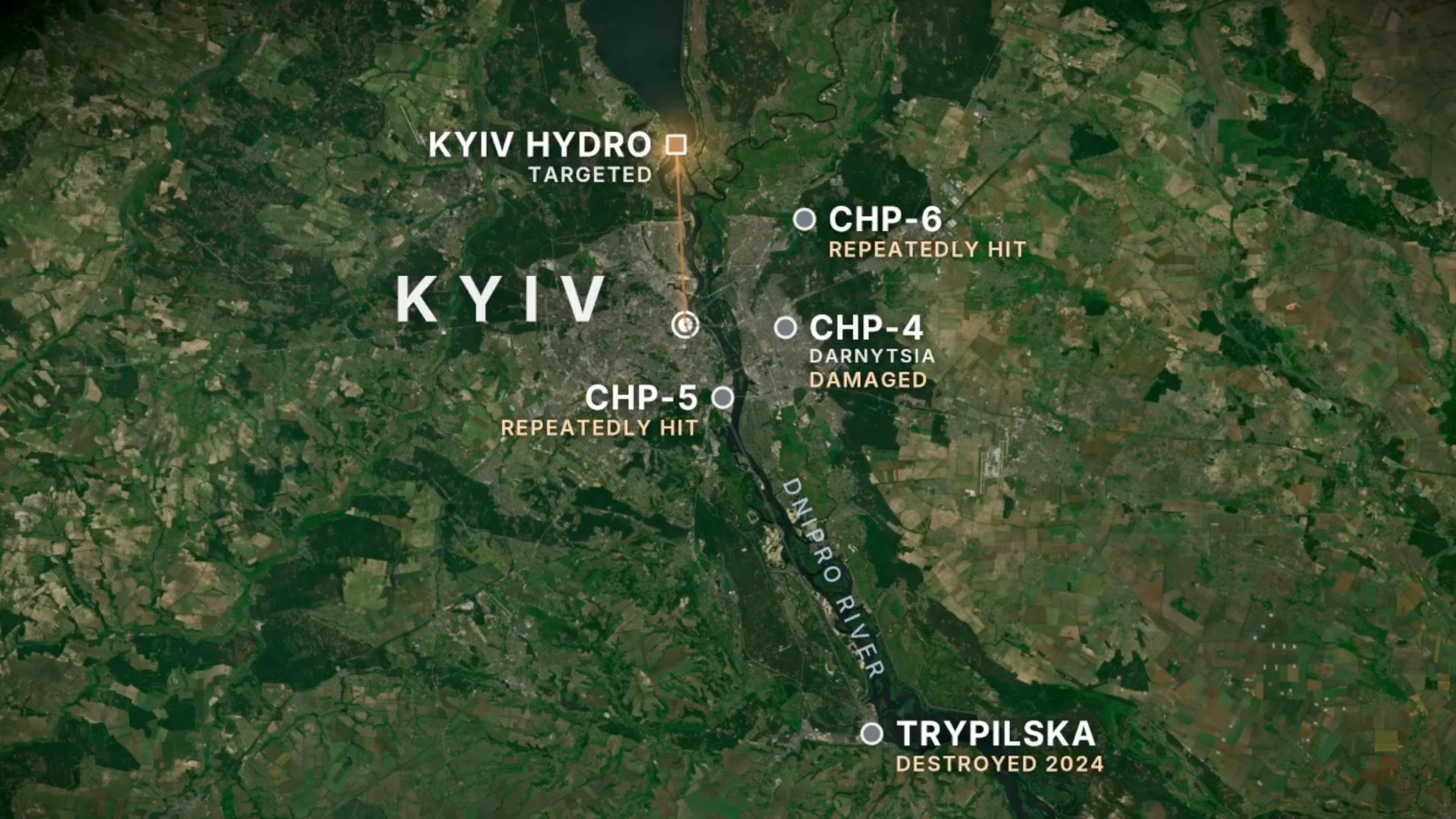


Kyiv no longer produces its own power. It can't.
On Wednesday, Russian attacks cut power and water across the capital and the surrounding region for hours. Residents were told to fill up at public drinking fountains. Emergency centers opened in the hardest-hit neighborhoods, handing out hot tea and places to charge phones. Water and power came back after repairs.
Russian strikes have gutted Kyiv's power plants. The city's two biggest heat-and-power stations have been hit dozens of times this year.
RELATED STORY | Zelenskyy says Ukraine got no early warning from partners as Russia hits the power grid again
On Tuesday, three more heat-and-power plants in Ukraine went dark. Russia fired 289 attack drones, 17 ballistic missiles and 59 cruise missiles at nine regions, President Volodymyr Zelenskyy said. DTEK, Ukraine's biggest private power company, said all three of its plants stopped generating and called it one of the "most serious attacks ever." No one was hurt at the plants.
Overnight into Wednesday, Russia sent 310 more drones, 81 of them jet-powered. Ukraine's air force said it shot down or disabled 272.
So where does Kyiv's power come from now? Mostly nuclear: three plants, roughly 200 miles away. They are the Rivne, Khmelnytskyi and South Ukraine nuclear plants. A fourth, Zaporizhzhia, is occupied by Russia.
The weak point is everything in between: high-voltage lines and a handful of big substations. And Russia knows it.
Hit a reactor, and you risk a radiation disaster. Hit the wires, and Kyiv goes dark anyway.
But even that tactic poses risks. On Tuesday, three drones went after the substation Khmelnytskyi's reactors rely on. Ukraine's energy minister called it a threat to "the nuclear safety of all of Europe."
IN CASE YOU MISSED IT | Russian drone strikes crowded Ukraine train platform, killing at least 13
Zelenskyy said halting strikes on energy and critical infrastructure is among Ukraine's priorities for U.S.-brokered peace talks Nov. 10-11 in Abu Dhabi.
Meanwhile, Kyiv is relying on a workaround called "islands": strategically placed, gas-fired plants that keep hospitals and water pumps running.
It's a Band-Aid, covering a fraction of what a city of 3 million needs.
And here's the twist. Analysts say the islands break the grid into pieces, all of them vulnerable to Russian attacks that appear aimed at making Ukraine's capital uninhabitable.
