

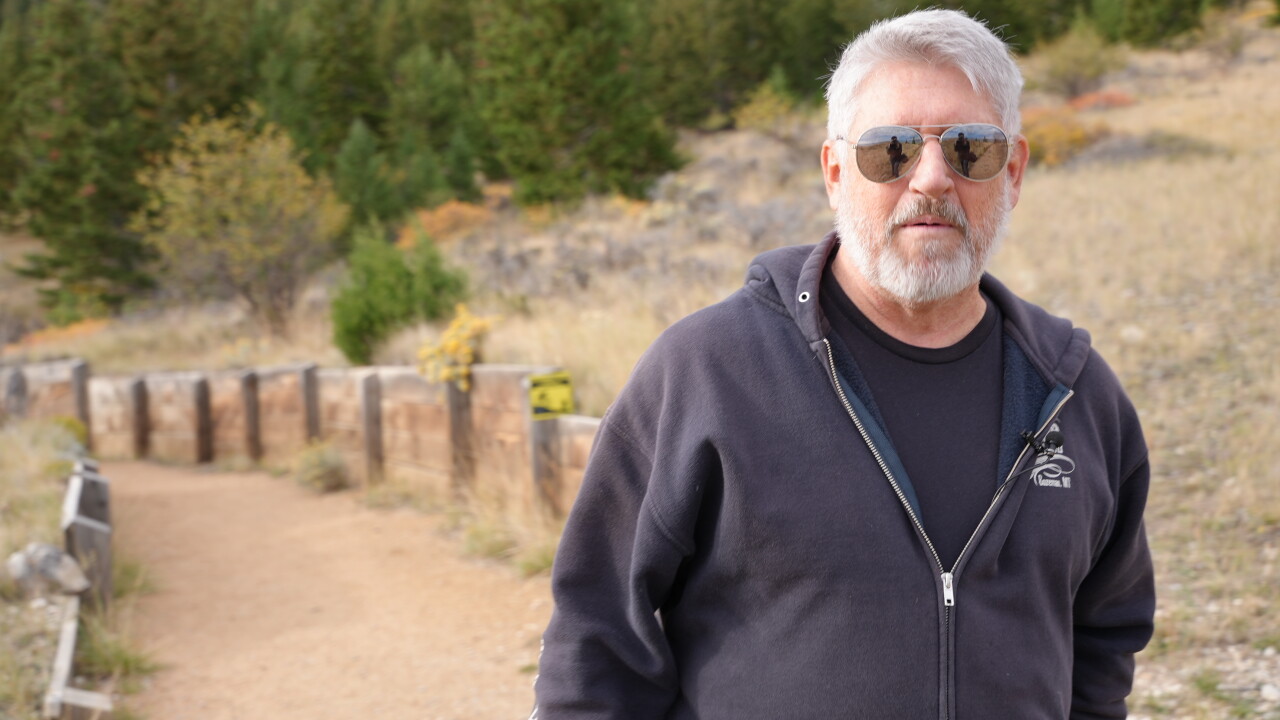


HELENA — U.S. Rep. Troy Downing says, while serving as Montana’s state auditor, he frequently left his office and hiked the trail to Mount Helena after work.
“There's something really neat about ending your day on top of this mountain, looking at the whole valley below you and watching the sunset – it's really spectacular,” he said.
Now it’s a trip he’s not able to make as often, as he represents the state in Washington, D.C. However, MTN joined him on the trail for one recent visit.
“Being in Congress, it's a much, much different schedule; I don't have really as much time to take advantage of opportunities like this,” he said. “But on a typical day in D.C., I get about 15,000 steps in, just going back and forth to hearings, back to my office, to meetings to votes on the House floor.”
(Watch the video to hear more from Downing.)
As Downing seeks a second term in Congress, he says he’s been serious about putting in work for his constituents – from considering policy in committee to meeting with stakeholders to finding common ground with other members.
“What I think some people don't understand is when you're on the floor and you're doing votes – I mean, that's the end of the work; that's not the work,” he said.
Downing, 59, grew up in California and has had a home in Montana since 1998. He had a varied career in business, then served in the Air Force after 9/11. He was elected state auditor in 2020, then passed up a chance for a second term to run for Congress in 2024.
The 2nd Congressional District covers much of central and eastern Montana, including Great Falls, Helena and Billings. It is the second-largest congressional district in the U.S., behind only Alaska’s at-large district.
“I get a little jealous sometimes, because I have colleagues who can walk across their district and I've got – well, everybody in Montana knows how far it is to go from one corner to the other,” he said. “I still love getting out there.”
Downing and his wife have kept their residence in Helena, but he says he doesn’t spend much time at home because he’s trying to visit all parts of the district.
“It's really important to me that we're available across the district, not just in the population centers,” he said.
Downing currently serves on two House committees. The first, Financial Services, means he’s dealing with hot-button issues like housing, monetary policy and artificial intelligence. He was appointed to the second, Natural Resources, earlier this year – and he says it came after he’d taken time to sit in on the committee’s hearings on issues that affected Montana.
“In Congress you can just do the minimum, or you can reach out and participate in other committees that you're not on,” he said. “It runs you ragged, but sometimes that's how you get really good policy through.”
In 2024, Downing won election by 30 points over his Democratic opponent. This year, as he faces Democrat Brian Miller, independent candidate Michael Eisenhauer and Libertarian Patrick McCracken, national political analysts have projected him as a strong favorite to be reelected. However, it’s much less certain whether Republicans will be able to hang onto their narrow majority in the House.
Downing argues, if Democrats take control of the House, the new committee chairs will be focused on scoring political points rather than getting things done.
“I can work with both sides of the aisle; I just want people that are serious about policy and not just the political vitriol,” he said.
He says some of his proudest accomplishments the last two years have been how his office has directly helped constituents who are having issues with federal agencies.
“End of the day, I want to make sure that everybody understands that we're there to solve problems for the people of Montana’s 2nd District,” he said.
See Troy Downing’s extended answers on specific issues:
Should the federal government be putting more restrictions on data centers? Should local communities have an absolute right to say no to construction in their area?
“I think that, like most industry, that the federal government should not be telling states what they must or must not do. I think the real answer is kind of like what we saw in Dawson County about a year or so ago, where they decided that they wanted to put restrictions on windmills, on setbacks and maximum heights, and so the people of Dawson County got together and set those restrictions. I think that's the exact same way it should be. So if the people of one county decide that they're interested in the jobs and the tax base and can handle the strain on infrastructure and natural resources, then that's their decision, and if some county decides not to – or some state decides not to, on a larger scale – then that's their decision as well. But I don't think the federal government should be telling any state what industry they must or must not have. I think that it's absolutely something that should be handled on the local level.”
Are there actions Congress could be taking to help improve the supply of accessible, affordable housing in Montana?
“Absolutely. As I travel around the state – and we put in a lot of miles hitting the frontier towns, the larger towns, I've got the biggest city in Montana, Billings is my district. As we travel around and we see the issues that are happening, especially in these more rural areas of the district, for finding nurses and doctors and teachers and ranch hands – employees all across the board – one of the biggest limiting factors that we have or that we hear about is that some critical access hospital will try to bring in some nurses, they'll get a bunch of applicants, and then those applicants will rescind the applications when they find out they can't find housing. This is a huge issue. I know that the term ‘American Dream’ is probably a little bit overused, but it's real, and we need to make sure that we protect it. A big part of the American Dream is the expectation to be able to find housing, and it bothers me that now the median first-time homebuyer is 40 years old. So what does that mean to a family just starting out, trying to buy their first home to raise their family, and it's gotten farther and farther out of touch. So I'll say that I was really happy: I sit on the Housing and Insurance Subcommittee on Financial Services, and the 21st Century ROAD to Housing bill became law about two or three months ago. And so you'll start to see that hit the ground, in access to capital for first-time buyers, in building infrastructure and taking some of the, regulatory hurdles away from producing affordable housing – like the requirement of chassis on modular housing. There's so many things that we do to make it quicker, easier, less expensive to get housing supply into the market and have programs so that people can afford that. One other thing that I've been championing is making sure that Indian Country is not left out of that conversation. So NAHASDA, the Native American Housing Assistance and Self-Determination Act, it's about a 30-year-old program that hasn't been reauthorized in about a decade and a half. I brought a bill to reauthorize that, and I just did the hard work of going on the House floor and going both sides of the aisle and finding colleagues that would co-sponsor that. I found 50 co-sponsors, almost 50-50 Republican-Democrat, for an Indian housing bill. I think it's really important so that we're solving the solution across the district, not just in certain parts of it.”
Are you supportive of the more aggressive federal immigration enforcement we’ve seen under the Trump administration?
“I think that what we saw in the previous administration was just a complete absence of a border, and you can't call yourself a country if you don't have borders. I'm really happy that we've brought that from millions down to zero – I think that's important. That doesn't mean that we're anti-immigration; it just means we're anti-invasion. We need to make sure that we have people crossing the border that we know who they are, we know what their intentions are, that we set the parameters for how many and when and how they make it through. So I'm happy that we don't have that porous border, so we don't have bad actors coming across, we know who's coming across, and we know that it's not folks that are coming here to try to harm us. But the other part of that is we need to keep growing as a country, and that's part of the fabric of the United States of America. As you look at the need for workers in a country, or even in a state like Montana, where we have an aging population, we have fewer and fewer workers – one of the biggest limiting factors that we have for businesses to succeed in Montana is their ability to recruit and retain workers. As that supply gets smaller and smaller, we need to start being really smart about where that comes from. And I'll just say, my family immigrated here – my great-grandparents from Iceland, they came to America through North Dakota and became Americans. I think we should invite people that want to come to the United States of America to become Americans, not to try to change this into the place that they came from.”
Do you think the Trump administration’s tariff policy has been successful?
“I think that it's really opened a lot of eyes in terms of countries that have not had fair trade policy with us. I understand there have been some pain points there. But if you think about really two of the goals here, one is having fair trade policies with our trading partners – and I think that we should be asking for that – and then the other part that's, I think, a little bit more of a painful part is having encouragement to repatriate manufacturing. There's a lot of jobs that have gone offshore that we no longer do in the United States of America. To the point that we can have pressures to make it economically feasible, or at least on par, to bring manufacturing jobs back to the United States, I think that's a national security issue, and I think it's a national economic issue. Even though there are some pain points with this moving target of tariffs, I think the goals are important – the goals of having a productive manufacturing sector in the United States, and making sure that we have equal fair trading policies with our trading partners.”
Should anything be done to help Montana businesses who say they’ve been harmed?
“I think that there's a lot you can do in tax code to help them, and I think that that's something under Ways and Means that we can look at. In terms of being harmed, really a part of that is I think this is a growing pains stage, where we'll start to see more and more options of domestically produced product, where it becomes somewhat moot – but in the meantime, we don't want to put anybody out of business. So, really looking at tax policy on how you can get to a breakeven on that, if you are being harmed by higher tariffs.”
Do you want to make any changes to the tax policy Congress passed in the “Big Beautiful Bill” last year?
“I'll just say that what we did in that reconciliation bill, I think, was incredibly meaningful. We prevented the largest tax increase in American history. There's a lot of rhetoric about who this helped or who it helped more, but I'll tell you: If you're rich, you got a tax cut; if you’re poor, you got a tax cut; if you're in the middle, you got a tax cut – this was across the board. Going back to just a basic principle, the biggest driver of success is access to capital, across the strata, whether you're just starting out or whether you've been successful in life. Access to capital is a huge part of that, and the best capital that you can access is your own. Having tax policy where there's more of your money in your pocket, I think, not only drives your success, but drives the economy's success – and I think that that helps everybody.”
Do you want to see further changes to eligibility requirements for benefits like Medicaid and SNAP?
“I think that the changes that we put in there are reasonable, and I think they actually drive a healthier population as well. Work requirements – there are some naysayers that say, ‘Well, there's no work where I live.’ Well, there's options – you can be looking for work or you can do community service. There's so many things that I think really will push for a healthier population anyway and get more people off of those services because they no longer need them. Having that little bit of incentive, I think, is a very positive thing. The least that we can expect as taxpayers is that somebody will at least make an attempt to help themselves. I think that encouraging people to not help themselves is going the wrong direction and creates a bigger and bigger problem, rather than giving people tools to actually help themselves and start to find pathways off.”
Social Security is projected to be unable to pay full benefits by 2032. How should Congress respond?
“This is a huge issue, going back to what I was talking about, with an aging population and with a dwindling population. There are some estimates saying that by 2030, just three years away, that we're going to have our first net loss in population – we're not reproducing our population. So as we start to see that wane and we see the population moving older and older, this becomes a huge problem. When a lot of people don't understand is that the Social Security taxes that you're paying right now is paying for retirees right now. When there were 60 workers per retiree, that math made sense. Now that we have, I think, two or three workers per retiree and getting worse, the math is really hard to make that pencil. There's a lot of things people are looking at, from raising the caps to raising benefit times to having means testing. But I'll just tell you, this is going to go off a cliff if we don't have smart people willing to actually talk about this entire universe of possibilities, because the simple math does not work. Even the fact that people have paid into this their entire working careers – some paid into it 30, 40, 50 years, and there's an expectation of them having benefit out of this, but that money has for the most part been spent paying for retirees while they were working. The other part of that, too, is that folks are taking benefits longer, and so many of them are actually taking a lot more money in their retirement years than they ever paid into it in their working years. The math just doesn't work, so we need to really have the intestinal fortitude to figure out what we do to keep the promises of the folks who are expecting and need these programs, and keep it from going off the rails – which it's going to do sooner rather than later.”
What role, if any, should the federal government play in regulating abortion?
“I think that the Supreme Court decision on Roe v. Wade was correct, that there's not a constitutional nexus and that falls upon the states. I'm a strong believer that that should fall upon the states. For me personally, I'm happy I was here, and if I was born a couple of years later, I would have been subject to Roe v. Wade, and I probably wouldn't be talking to you right now.”
Do you support the Trump administration’s decision to repeal the nationwide Roadless Rule?
“I think that the policy issue there is sound. We all care about our natural resources, we care about our public lands, and we care that they're still there. Look where we're at: We're up on top of Mount Helena right now. Look at this beautiful view; you see the town of Helena behind us, on the other side, I'm just looking at forests and hills and mountains and it's absolutely beautiful. We all care about maintaining that. I think that the other part of that is we need to have access: access for fuels management, access for fire support, to make sure that if we do have one of these events – these hotter, bigger, faster burning fires – that we have the means to, first of all, mitigate it from happening in the first place, and second of all, be able to battle it once it happens – because we're not helping anybody if you let a hot forest fire burn and sterilize an entire forest. So I think that we need to have some happy ground there, where we have access so we can do fuels management, we can do forest management and we can have access in the case of a forest fire.”
Do you want to see changes in how the federal government manages federal lands?
“I think that the Fix Our Forest Act is good policy, and that deals with a lot of these issues we've already talked about – actually managing our forests, managing fuels, managing access. I'm a former land commissioner – sat on the Board of Land Commissioners for the state of Montana – and a lot of the stuff that we dealt with in dealing with our state public land, our state trust land, was we want to have multiple use, and we want to have sustained yield, and we want to make sure that we're preserving the things that are important to every Montanan. And there's a thoughtful way of doing that – it's not a binary choice of either you manage it or you completely keep it hands off. I think, in the grand scheme of things, that thoughtful management allows us to keep this generation after generation.”
How do you think the U.S. should be approaching the ongoing conflict in Iran and the Middle East?
“This is a tough one. A lot of folks will say this is a war of choice, but this was not a war of choice with Iran. They've been at war with us since 1979, and to think otherwise is being naïve, because they have killed and maimed Americans – they've been doing that ever since the ayatollahs took over – and they have actively been working on having nuclear weapons. The world – not just the United States, not just our allies, the world – cannot afford to have an Islamist regime that has access to a nuclear weapon. The world is not a safe place if we allow that to do it. As unpopular as this is and as tough as this is, and obviously we've seen some economic strain because of that. I don't diminish that at all, there's people hurting, especially on the cost of energy. The other side of that equation is having a nuclear-powered Islamist regime does not make this planet a safe place. I think that we need to see it to the point where there is no possibility of that regime having access or the ability to build or acquire nuclear weapons.”
