




HELENA — A representative from Montana Secretary of State Christi Jacobsen’s office appeared before a legislative committee Thursday, to answer questions from lawmakers about the office’s public mailings and their handling of state voter data.
Austin James, Jacobsen’s elections director and chief legal counsel, spoke to the Legislative Audit Committee.
(Watch the video to hear more of the questions lawmakers had for the office.)
In January, committee members pressed for more information on how the Secretary of State’s Office paid for more than 466,000 postcards, mailed to households across the state. The postcards showed Jacobsen standing beside President Donald Trump, and they announced her office’s agreement to use a federal database to check whether registered voters in the state are U.S. citizens. They quickly drew public attention – and criticism from people who argued they were political in nature.
“Whatever you think about our approach. It is indisputable that it was highly effective,” James said Thursday.
James said using the federal Systematic Alien Verification for Entitlements, or SAVE, database had already helped the state identify about 900 dead voters they hadn’t been aware of, in addition to an already announced dozens of potential non-citizens who were registered. He said the use of that tool would normally cost the state more than $1 million, but the federal government had waived the cost, so he saw that as a savings that offset the cost of printing and mailing the postcards – estimated at around $200,000.

In previous committee meetings, James said he didn’t have an answer on where the funding for the postcards came from. He accused lawmakers who continued to push for a source of the money of “dishonest politicking,” saying the office didn’t even make payment until March, as they had 60 days to pay the invoice to State Print and Mail.
“In my opinion, a scandal was manufactured where none exists,” he said.
James said the office ended up using federal grant money through the Help America Vote Act, which is earmarked to help states upgrade voting systems and “improve the administration of federal elections.”
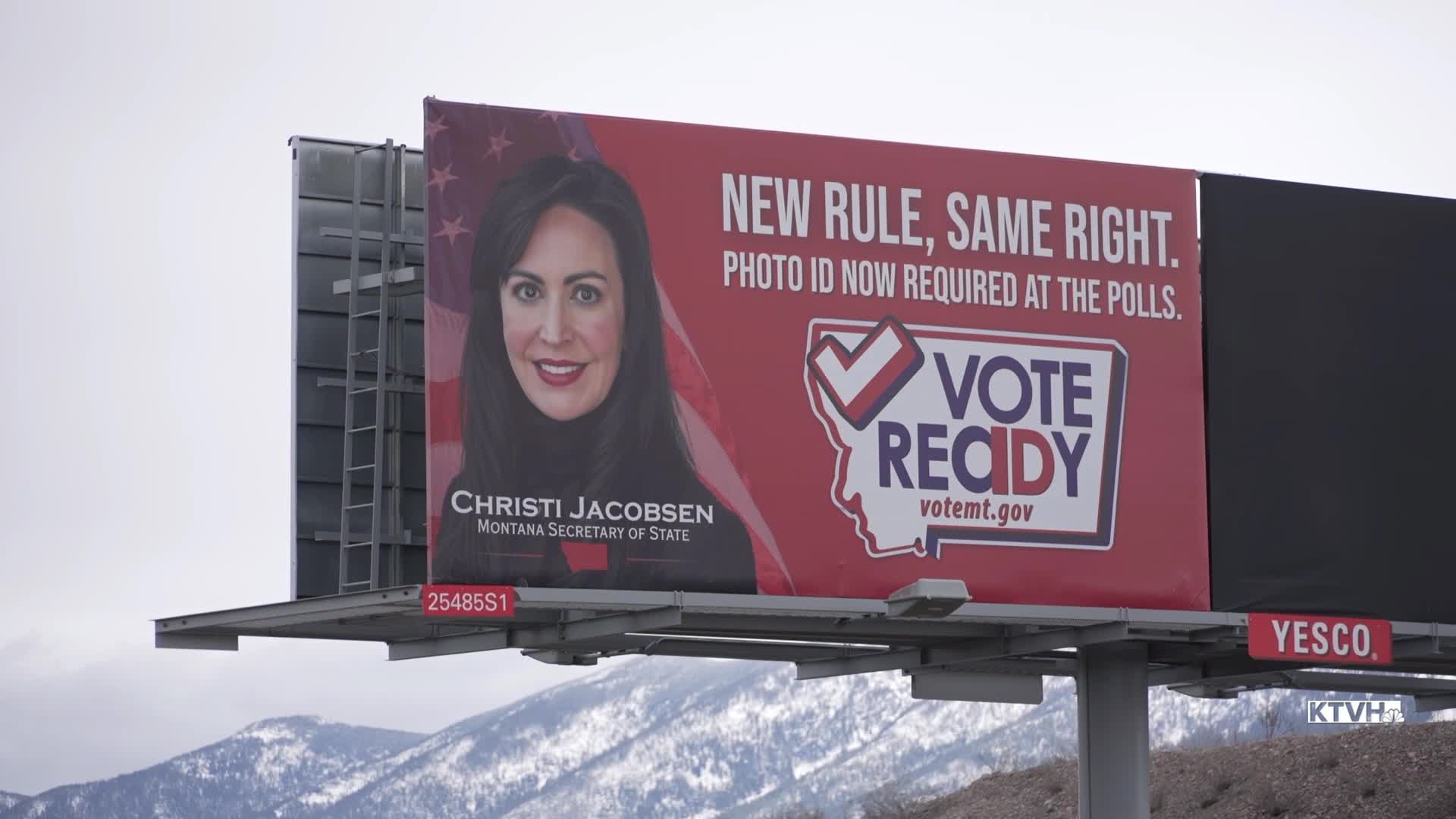
A few months after the postcards went out, the Secretary of State’s Office again ended up in the spotlight when a series of billboards featuring Jacobsen went up along highways around Montana. They refer to Senate Bill 276, a law passed by the 2025 Legislature that implemented stricter voter ID rules – requiring any ID be “current, valid and readable,” and removing a procedure for someone to vote a provisional ballot without photo ID if they sign a declaration swearing they have a “reasonable impediment” to getting ID.
James said the billboards would likely be funded through the Secretary of State’s general budget – meaning the money the office makes through things like business registration and candidate filing fees. He said the office builds planned public outreach for new legislation into their budget.
“We assured this body last year, in fact, in the State Administration Committee, when the voter ID bill was up, would our office conduct robust outreach for that voter ID bill?” James said. “And our answer on the record was yes, we would conduct robust outreach for the voter ID bill.”
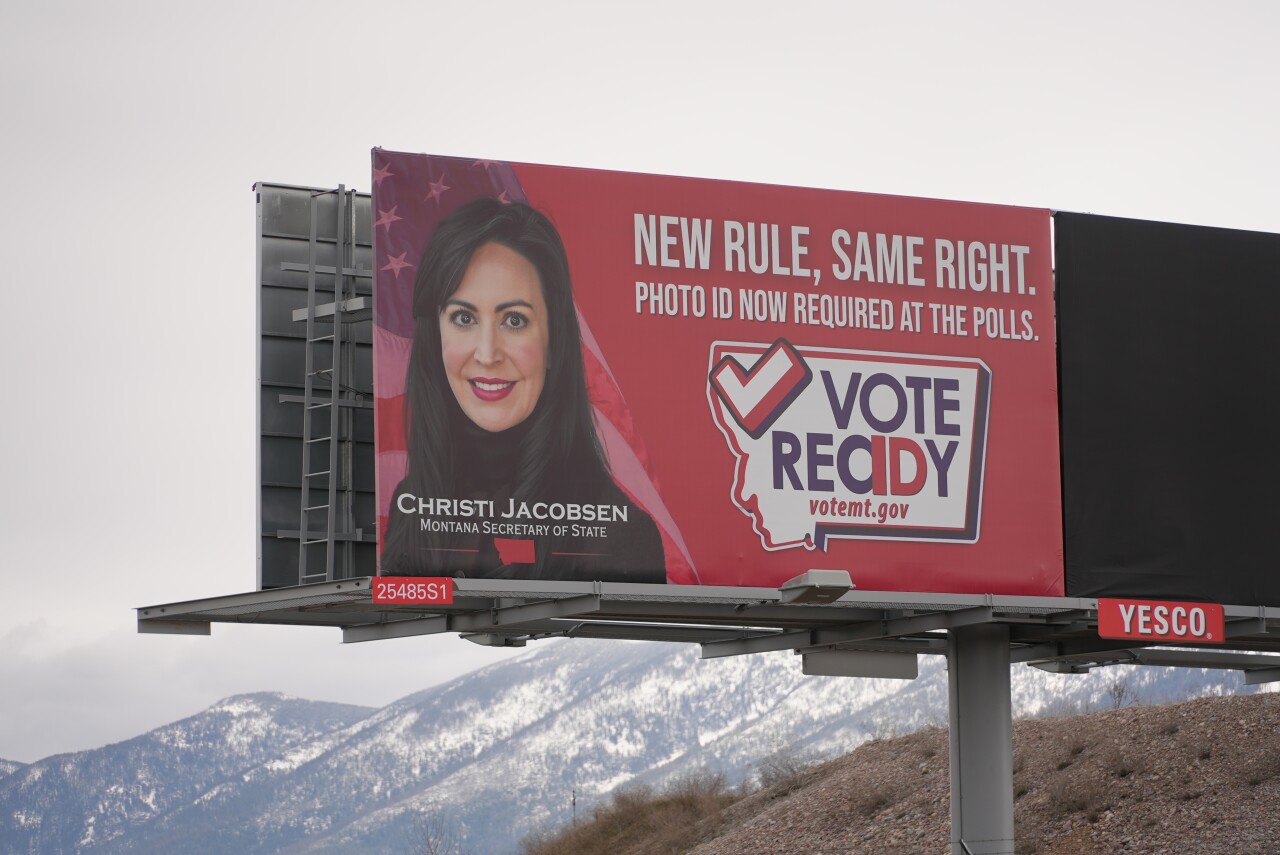
The billboards went up around the time Jacobsen filed as a candidate in the Republican primary for U.S. House in Montana’s western congressional district. Montana Commissioner of Political Practices Chris Gallus received a complaint about them, claiming that they were political rather than related to Jacobsen’s official duties. Gallus dismissed the complaint – as he had an earlier one objecting to the postcards – citing previous rulings that public officials hadn’t violated the Code of Ethics by using public funds to produce public service announcements featuring their likeness.
James said Jacobsen’s prominent appearance on the postcards and billboards was justified by the message they were trying to get across to the public, and that future voter outreach on issues like late registration and absentee ballot rules wouldn’t necessarily feature her face.
“The single attribute of a photo ID is a headshot; the billboard has a headshot,” he said. “There is no attribute of registration lines that contain a headshot; therefore, there will not be a headshot on the registration line outreach. A partnership is generally imaged by two individuals that are partnering, standing next to each other or shaking hands.”
Also during Thursday’s meeting, committee members asked James to provide more answers about how Jacobsen has handled the federal government’s requests for the state’s voter data.
“I have had constituents who have been feeling like the office, whether intentional or not, has really been hiding the ball on what voter information was given over to the federal government,” said Sen. Laura Smith, D-Helena.
The Trump administration has asked states to share their full voter rolls so that federal authorities can review them and identify registered voters they believe may be ineligible. Some opponents have warned that collection of data is a threat to voters’ private information.
According to a Montana Free Press article, Jacobsen’s office initially turned over Montana’s public voter file, but the U.S. Department of Justice asked for more detailed information not made available to the public, including voters’ full dates of birth, driver’s license numbers and the last four digits of their Social Security numbers. The article said the office submitted more information after that, though Jacobsen responded in a social media post by saying she had not released the full unredacted voter rolls.
James said Thursday that the Justice Department asserted a right under federal law to inspect state documents, including the voter rolls. He said the Secretary of State’s Office responded in a way that they believed complied with both federal and state requirements. However, he said he was reluctant to provide more specifics because of the possibility of litigation.
The Trump administration has sued about 30 states for not providing all the voter data they’ve asked for.
During Thursday’s meeting, lawmakers repeatedly asked James to give more specifics about what information Jacobsen’s office provided and how their later release was different from what they submitted initially.
“Why is it such a big secret what you submitted to the federal government?” asked Rep. Sherry Essmann, R-Billings. “That's what I want to know.”
Each time, James returned to his statement that the office had complied with Montana and state law, but that he couldn’t give more details considering the ongoing threat of litigation.
“We're all Montanans that understand the interest,” he said. “There is a Supremacy Clause, as you know, and an allowability for the chief law enforcement officer to inspect our books. Simultaneously, our Secretary of State is very protective of privacy. Should we get the opportunity to litigate this, I sure as hell hope that there's precedent in our favor at the time that that comes – but I don't want that time right now.”
