

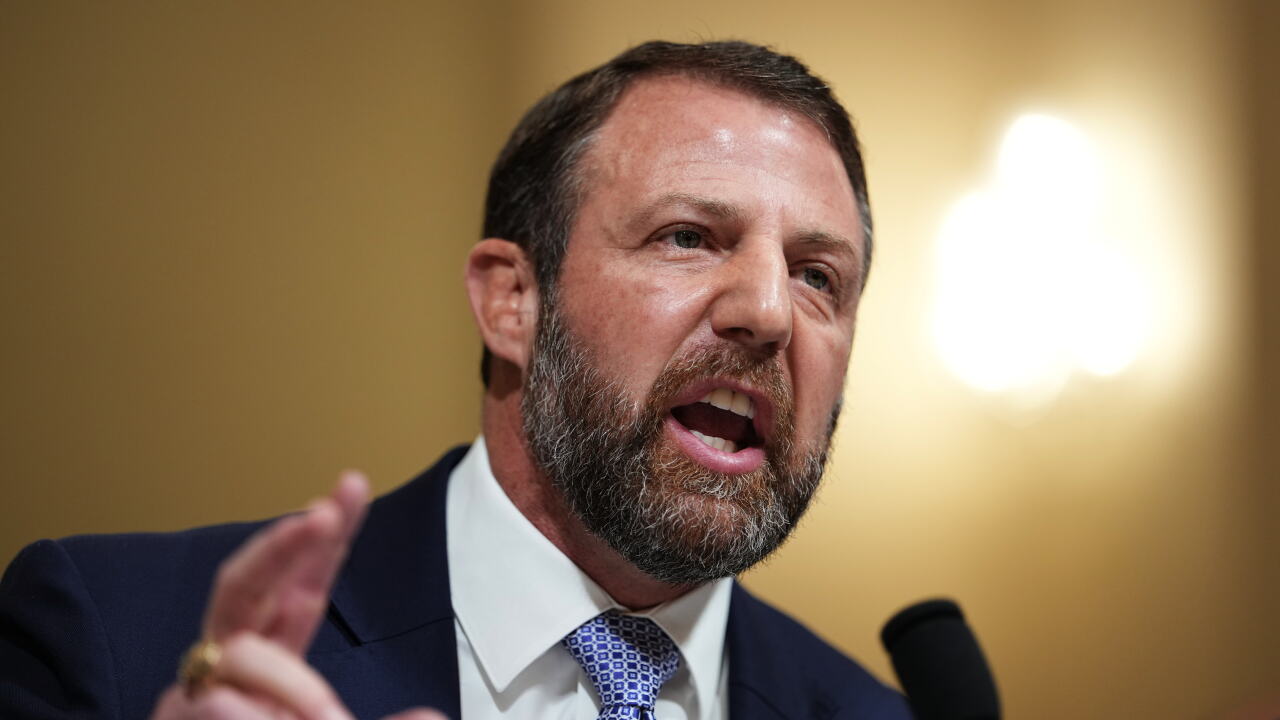

Homeland Security Secretary Markwayne Mullin defended before a House committee Wednesday his flight to a weekend LSU-Texas football game as travelers across the U.S. were still stuck at airports after the nationwide grounding of flights, saying canceling it could have caused confusion.
Mullin spoke at a congressional hearing about threats facing the country at a time of looming questions over cyber infrastructure, the future of immigration enforcement and his decision to fly to the college football game.
The hearing in front of the House Homeland Security Committee is a standard yearly opportunity for members of Congress to grill top administration officials over national security threats. But it comes as the U.S. has faced a series of cyber and technology problems that have left Americans feeling vulnerable.
The hearing is also the first opportunity for Democrats after their midterm drubbing of Republicans to grill the Cabinet official who is key to President Donald Trump's mass deportation agenda. Two others facing questioning are FBI Deputy Director Christopher Raia and the Trump administration's national intelligence director, Jay Clayton.
Mullin flew to a football game as travelers were scrambling
The secretary has faced scrutiny over his decision to fly to Louisiana on Saturday to watch the LSU-Texas game.
Mullin's flight took place after the stoppage was lifted and as planes were back in the air. But thousands of flights were canceled because of the ground stop, and Mullin flew as people nationwide were forced to scramble for alternative travel options.
On Wednesday, he said canceling the trip could have sent a confusing message.
Mullin said the trip had been planned for weeks so that he could take his nieces to the game and that there was discussion before the trip about whether to forgo it.
"If we canceled something with the airspace completely open, it could bring confusion because I was meeting the governor there. I was meeting other people there that would show maybe distrust that we're not even willing to fly," Mullin said.
Mullin had said Tuesday and reiterated Wednesday that he is required to fly on government planes and that he personally paid for the trip.
Mullin defends ground stop response
Mullin, whose department includes the agency tasked with protecting the country's cyber infrastructure, was front and center in the Republican administration's response to the grounding of all aircraft last week.
The Trump administration has said the ground stop was the result of problems with newly installed routers that caused the Federal Aviation Administration's telecommunications system to be flooded with data, forcing the agency to ground all flights while it addressed the issue.
At the hearing, Mullin pushed back on criticism that the administration wasn't giving the American public clear answers.
"We were able to put the planes back in the air safely. We landed over 4,000 planes when the ground stoppage went out because of the communication and didn't have one single incident. That in itself is a great success," Mullin said.
During a news conference Friday with Transportation Secretary Sean Duffy at the White House, he pushed for more funding for the aging air traffic control system while also assuring the public that the government was not seeing any signs of a deliberate cyberattack.
The Trump administration has been attempting to offer reassurances about a spate of outages over the last week that have affected everything from Microsoft and the Federal Aviation Administration to the banking industry, United Airlines and a classified internal communications network at the National Security Agency.
Top Trump administration national security officials have said there was no indication that the events are related or attributable to a cyberattack or hostile activity.
Clayton told the committee Wednesday that the outages are "not a coordinated or state-sponsored attack." Instead, they appear to be "separate service outages associated with maintenance and technical changes."
Mullin's sprawling Department of Homeland Security also includes an agency designed to play a central role in the federal government's response to cyber incidents. The Cybersecurity and Infrastructure Security Agency is tasked with working with industry to protect infrastructure, including water and electric generation, election systems, chemical facilities and cyber networks.
But CISA has been without a Senate-confirmed leader since Trump took office for a second term in early 2025. Trump's original pick to lead the agency withdrew his nomination earlier this year after it languished for months in the Senate.
CISA also lost staff last year during cuts aimed at reducing the size of the federal government.
Immigration enforcement under new scrutiny
Mullin, whose department includes Customs and Border Protection and Immigration and Customs Enforcement, faced questions over the Republican president's immigration agenda at a time when Democrats are vowing rigorous oversight of everything from immigration detention contracts to the use of force by ICE officers.
Trump has indicated he could work with Democrats on immigration legislation, but he has also elevated Stephen Miller, the architect of his immigration crackdown, to be his chief of staff, raising questions over how easily compromise could be reached on the issue.
Mullin took over from ousted Department of Homeland Security Secretary Kristi Noem in March after the killing of two American citizen protesters in Minneapolis at the hands of immigration enforcement officers forced the administration to adjust its mass deportation strategy.
Immigration arrests initially fell but then rebounded as ICE, flush with billions of dollars in new congressional funding, hired new officers and maximized cooperation from local and state law enforcement agencies across the country.
