

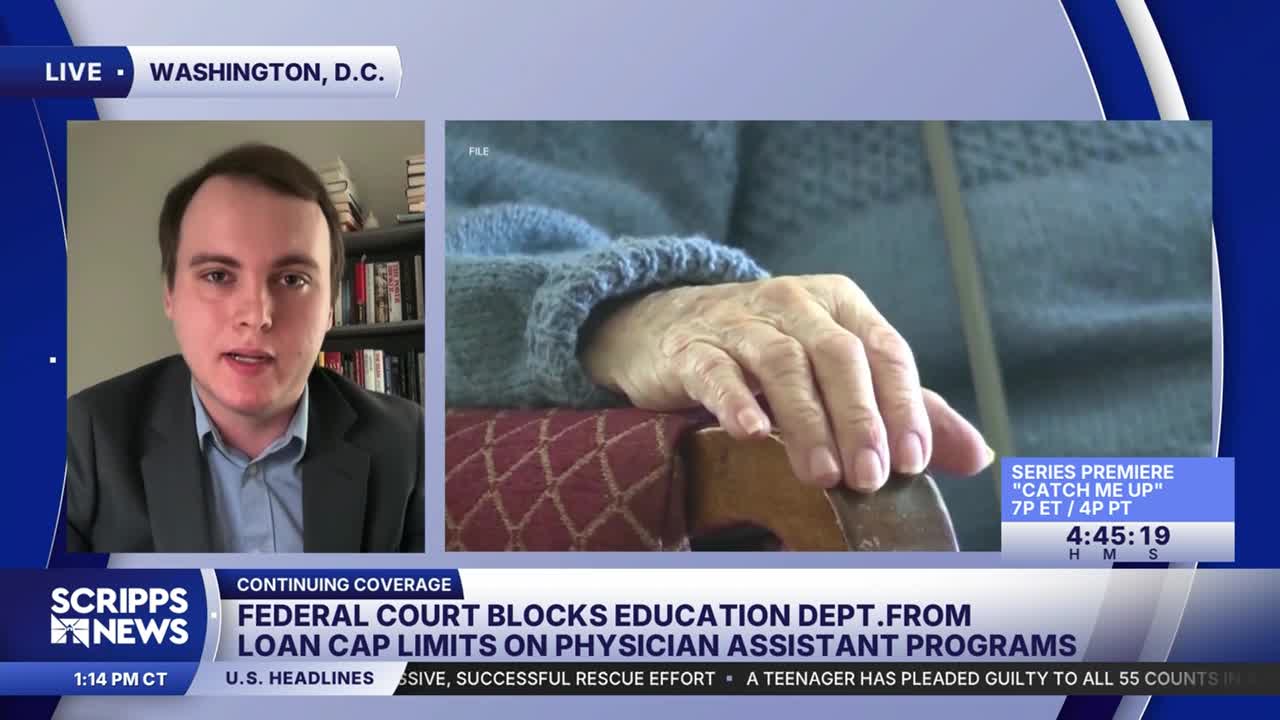


Last month, a federal judge blocked the Education Department from implementing new caps on certain types of student loans — a provision tied to the "One Big Beautiful Bill."
At issue: which degrees qualified for higher loan limits. Some programs, including law, veterinary medicine, and theology, were spared and could borrow the maximum amount. Physician assistant programs were not.
Most PAs rely on federal loan dollars to fund their education. The Physician Assistant Education Association, known as PAEA, was one of the plaintiffs in the suit challenging the department's restrictions.
Tyler Smith, chief policy officer for PAEA, said the ruling was a significant win — but not the end of the fight.
"On behalf of both PAEA and AAPA, we are thrilled by the court's decision. This decision provides important preliminary relief for PA students who are facing significant confusion over whether or not they'll have the ability to be able to fund their education," Smith said.
Smith said the relief gives students flexibility to cover tuition and housing, but emphasized that more work remains.
"I think it's important to note that the work is still ongoing. Congress can provide long-term certainty to students so that they're able to actually get through their programs and then enter the workforce and really fill the gaps in care we're seeing across the country," Smith said.
The core of the legal challenge centered on extra requirements the Department of Education sought to impose beyond what the law outlined. Under the One Big Beautiful Bill Act, students were supposed to qualify for professional student loans if they completed a post-baccalaureate program, held a license, and enrolled in a program that prepared them for academic practice.
Smith said the department went further than Congress intended.
RELATED STORY | Many student loan borrowers have entered default post-pandemic protections
"The department was attempting to say that you have to be at the doctoral level," Smith said. "They were attempting to say that you can be supervised in clinical practice. And so we were really thrilled when the court agreed that these additional criteria departed from what Congress required and really would have a devastating impact on the workforce."
The stakes extend beyond individual students. The U.S. is facing growing healthcare workforce shortages, particularly in rural and underserved communities — areas where PAs often serve as primary care providers.
"PAs are able to manage their own panels of patients. They can prescribe, diagnose, really provide the range of services that we expect from whenever we go to see a health care provider," Smith said.
Smith said the profession has grown substantially in recent decades, with more than 200,000 PAs now practicing across the country.
"Anything in the form of loan caps or restrictions on PA students' ability to access and finance their programs would have a devastating impact on the workforce."
RELATED STORY | Student loan changes take effect with new payment plans, borrowing caps
With litigation still ongoing, PAEA and the American Academy of Physician Associates are also pushing Congress to pass the Professional Student Degree Act, which would explicitly designate PA students as professional students and guarantee long-term access to federal aid.
"We're really urging legislators to co-sponsor and pass the Professional Student Degree Act that would explicitly name PA students as professional students over the long term and make sure that they have access to the aid they need to finish their programs," Smith said.
